
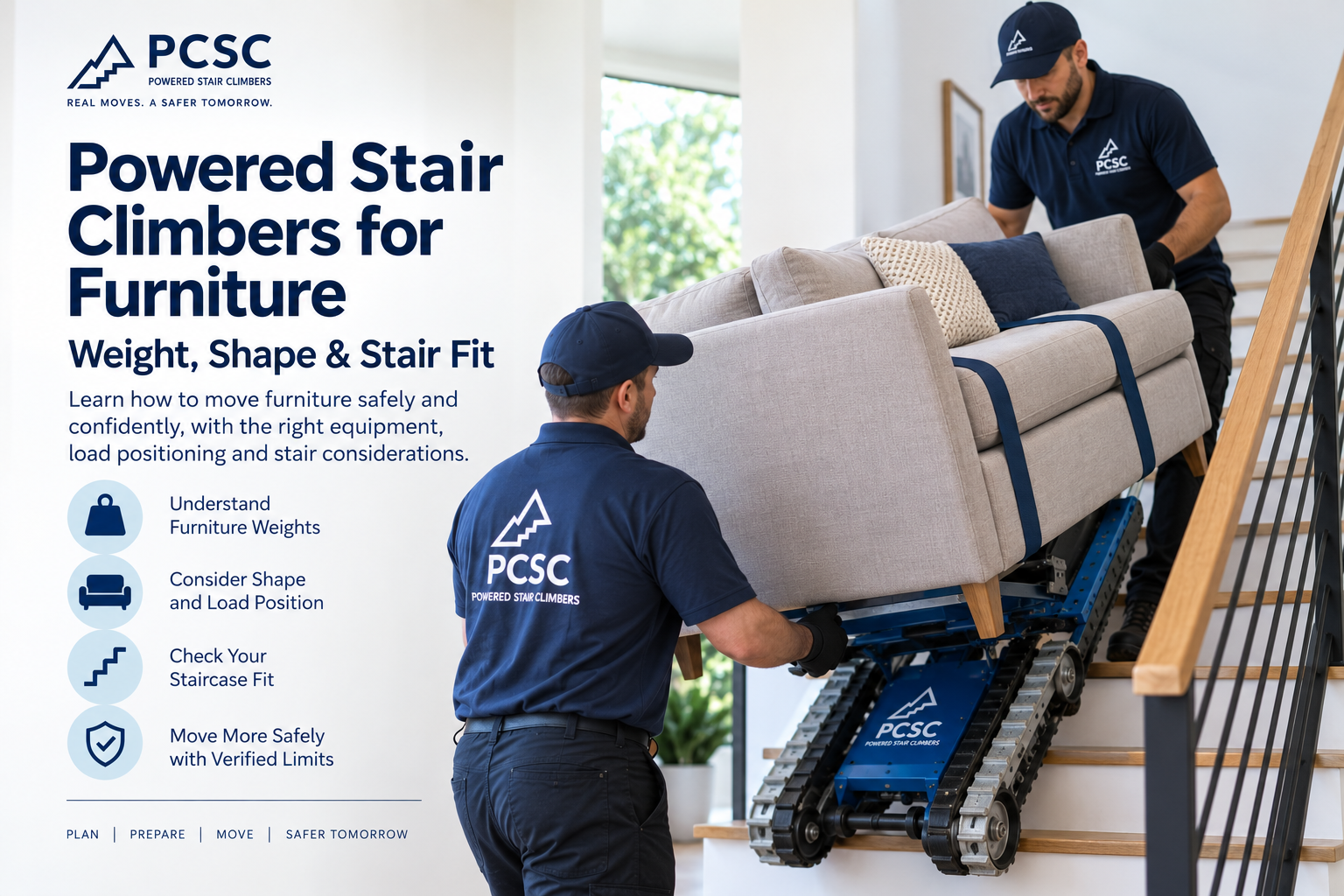
Moving furniture on stairs is not simply a question of whether a powered stair climber can carry the item’s stated weight. Sofas, cabinets, tables and other bulky pieces can be awkward because their shape, center of gravity and dimensions affect how the load behaves on the machine and whether the complete setup can clear the staircase.
This guide explains how to evaluate a powered stair climber for furniture using load weight, load stability, stair geometry, landing clearance and verified stair limits. The aim is to narrow the equipment decision before a move reaches the stairs.
Start with the actual furniture load
Establish the weight of the item being moved as accurately as possible. Do not treat a stair climber’s advertised rated capacity as proof that every load below that number is suitable for every staircase.
The rated capacity is a hard ceiling, while the usable limit on stairs can depend on the machine, load distribution, staircase and manufacturer guidance. Our powered stair climber capacity guide explains the difference between rated load and verified stair limits.
Furniture shape matters as much as weight
Furniture often creates handling problems that a simple weight figure cannot describe. A tall cabinet may place mass high above the machine. A long sofa may extend well beyond the stair climber frame. A wide table may be relatively light but difficult to turn on a landing.
Before selecting equipment, consider the complete loaded footprint rather than the furniture weight alone.
Check the center of gravity and load stability
The load needs to remain controlled as the stair climber changes angle on the staircase. An item with an uneven or elevated center of gravity can behave differently from a compact load of the same weight.
Consider where the mass sits relative to the machine, how the item can be secured, whether it can shift during travel, and whether its shape interferes with safe operator positioning.
Measure the staircase and the landings
A stair climber and its load must physically fit the route. Measure stair width, tread depth, rise, landing dimensions, turns, doorways and other pinch points before the move.
For bulky furniture, landing and turning clearance can become the limiting factor even when the load itself is within an otherwise acceptable weight range.
Consider the complete route
The staircase is only one part of the move. Check the approach to the stairs, the loading position, intermediate landings and the destination. Tight doorways or abrupt turns can make an otherwise workable staircase impractical for a particular furniture item.
One operator or two?
Do not infer operator requirements from rated capacity alone. Manufacturer instructions and verified load-limit evidence should determine whether a particular machine, load and stair condition supports one-person or two-person operation.
The Powered Stair Climber Selector uses verified evidence when determining whether a recorded configuration is eligible. Missing evidence is not treated as permission to assume suitability.
Furniture versus appliance moves
Furniture and appliances share several planning requirements, including load weight, stability, stair geometry and landing clearance. Furniture, however, can introduce especially irregular dimensions and load shapes.
If you are moving refrigerators, washing machines, dryers or similar equipment, use our separate powered stair climber for appliances guide.
How we evaluate suitability
PCSC separates manufacturer-rated capacity from contextual stair limits and does not use an unverified specification as evidence that a machine is suitable for a particular move. See how we evaluate stair climbers for the methodology behind our decision guidance.
Furniture stair-climber checklist
- Confirm the furniture’s actual weight.
- Check its dimensions and loaded footprint.
- Assess center of gravity and load stability.
- Determine how the item can be secured.
- Measure stair width, rise and tread depth.
- Measure landings, turns and doorways.
- Check operator requirements.
- Use verified stair-limit evidence rather than rated capacity alone.
For a specific move, first use the Stair-Fit Checker to precheck verified load and width constraints against the route, then use the Powered Stair Climber Selector to compare the load and staircase against the evidence available for verified configurations.
Sofas and couches
Sofas add a distinct fit problem because their length and overhang can matter as much as their weight. Our powered stair climbers for sofas guide covers load orientation, balance, stair geometry and landing clearance for these long furniture loads.