
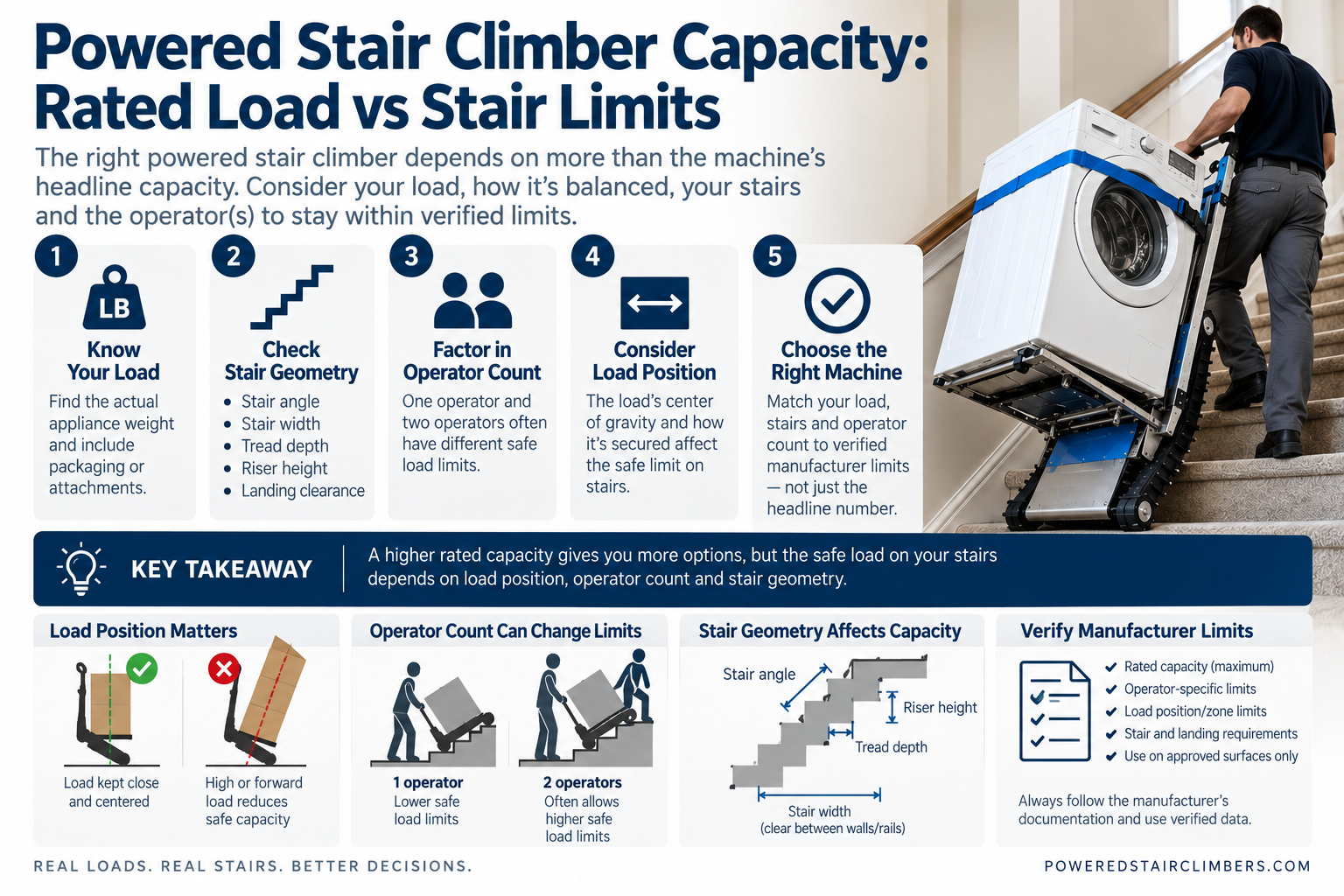
Powered stair climber capacity is not one number. A machine can have a high headline rated capacity while the verified load permitted on stairs is lower because of operator count, load position or other manufacturer-defined conditions.
This guide explains how to read those numbers as a buyer. It does not replace the manufacturer’s operating instructions, and it does not assume that a rated-capacity match is automatically safe for a particular staircase.
Rated capacity is the ceiling, not the whole answer
Start with the machine’s rated capacity. If your load exceeds that figure, the machine is not a match. But being under the rated capacity only clears the first gate.
For stair use, the next question is whether verified stair-climbing evidence supports the same load under the actual conditions of the move. Those conditions can include operator count and the way the load’s centre of gravity is positioned on the frame.
Why stair limits can be lower than the headline rating
A stair climber is working in a different environment on stairs than on level ground. The load is being supported and moved on an incline, and its position relative to the machine can change the effective operating condition.
That is why PCSC keeps rated capacity separate from contextual stair limits. When a manufacturer publishes different limits for one operator, two operators or different load-position zones, those limits are stored as separate evidence rather than collapsed into one marketing number.
Verified PowerMate example: L-1
Our current verified record for the PowerMate L-1 has a rated capacity of 650 lb. The verified evenly distributed stair-climbing limit is 450 lb with one qualified operator and 650 lb with two qualified operators.
The same manufacturer evidence also provides load-position zones. In the verified PCSC dataset, L-1 one-operator stair limits range from 200 lb to 450 lb across zones A1, A2, B1, B2, C1 and C2. With two operators, the corresponding verified zone limits range from 400 lb to 650 lb.
The lesson is not that one number is “better.” It is that a 650 lb headline rating does not mean every 650 lb load is supported in every stair configuration.
Verified PowerMate example: M-1
Our current verified record for the PowerMate M-1 has a rated capacity of 1,500 lb. Its verified evenly distributed stair-climbing limit is 450 lb with one operator and 1,000 lb with two operators.
Across the verified M-1 load-position zones, the one-operator stair limits range from 250 lb to 450 lb. With two operators, the verified zone limits range from 400 lb to 1,000 lb.
That gap between a 1,500 lb rated capacity and the contextual stair limits is exactly why a buyer should not select a stair climber from the headline rating alone.
Operator count is part of the capacity decision
If the verified manufacturer evidence provides different stair limits for one and two operators, use the limit that matches the planned operator arrangement. Do not use a two-operator load limit to justify a one-operator move.
Operator count is therefore an input to the capacity decision, not something to decide after the model has already been selected.
Load position can change the allowable stair load
Where a manufacturer publishes centre-of-gravity or load-position zones, use the zone that matches how the load will actually sit on the machine. Moving the load higher, farther forward or otherwise changing its position can place it into a different manufacturer-defined limit.
PCSC does not convert those manufacturer zones into a universal rule for every stair climber. They remain model-specific evidence.
Capacity still does not prove stair fit
A valid load-limit match does not prove that the machine and load can physically use your staircase. Stair width, riser height, tread depth, stair angle where specified, landing clearance and turning space remain separate checks.
For appliance moves, see our appliance stair-climber guide, including dedicated guidance for refrigerators and washing machines.
What if contextual stair evidence is missing?
PCSC treats missing contextual stair evidence as insufficient evidence. We do not assume that the headline rated capacity can be substituted for an absent stair limit.
This is also why models can exist in our research database without appearing as public recommendations. A model record and a verified, decision-ready stair-capacity record are not the same thing.
How our selector uses capacity
The powered stair climber selector uses rated capacity as a hard ceiling, then requires matching contextual stair evidence before treating a model as eligible for the requested conditions.
For the evidence rules behind that process, see how we evaluate stair climbers.
Capacity checklist before choosing a model
- Establish the actual moving weight of the load.
- Reject any model whose rated capacity is below that load.
- Identify the operator arrangement you will actually use.
- Identify the applicable load position or manufacturer zone where required.
- Check the verified stair-climbing limit for that exact context.
- Do not substitute a headline rating for missing stair evidence.
- Check stair geometry and landing clearance separately from capacity.
- Confirm the final decision against the manufacturer’s current operating documentation.
The key decision
The capacity you actually need is not simply the weight of the load plus a safety margin against the biggest number on a product page. The useful number is the verified limit that matches the load, its position, the operator count and the stair context at the same time.
Use the selector to apply that evidence gate to the currently supported models rather than comparing headline capacities in isolation.