
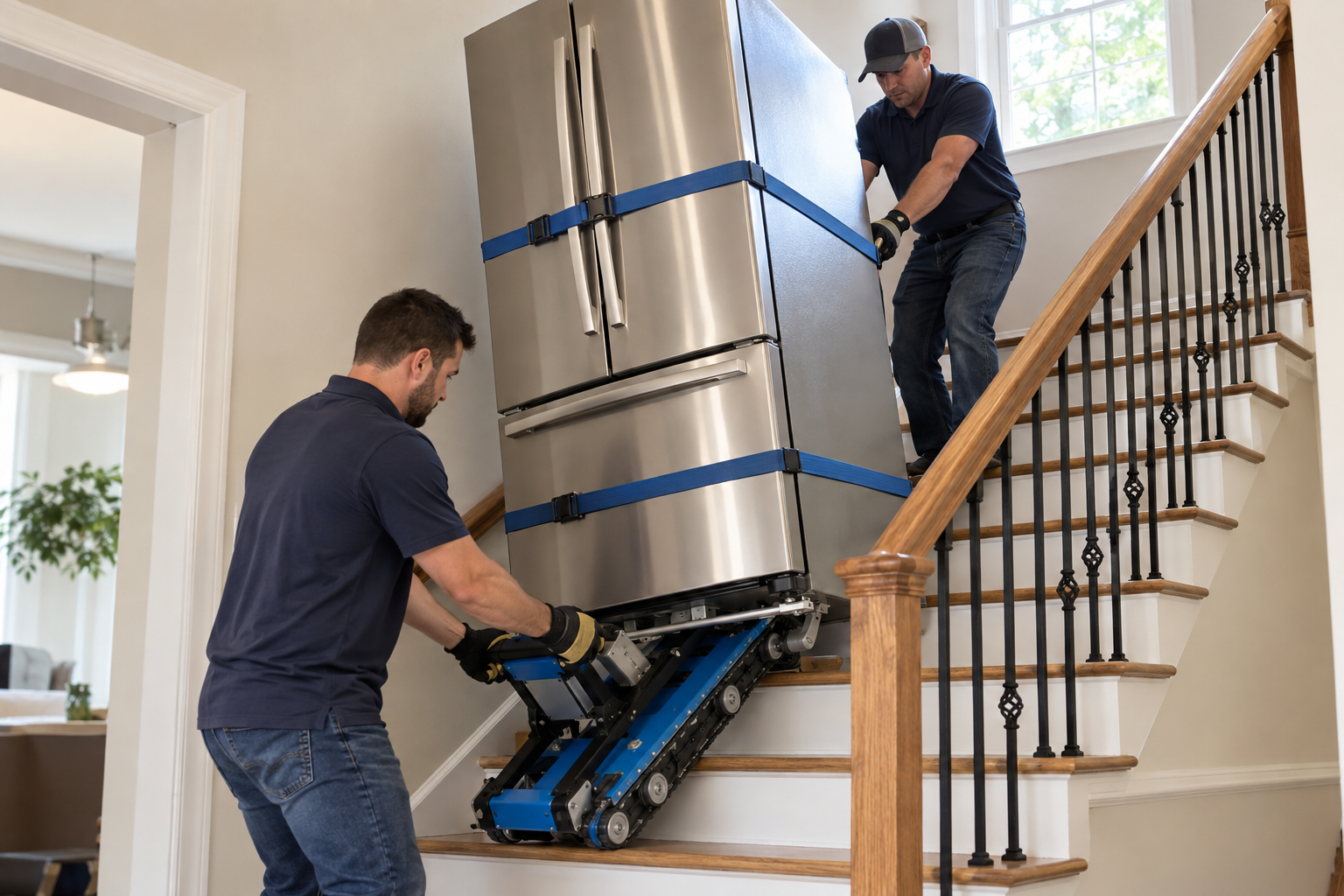
Moving a refrigerator on stairs is not simply a question of whether the appliance weighs less than a stair climber’s advertised capacity. Refrigerator height, balance, stair geometry, landing space, operator count and the machine’s verified stair-climbing limits all affect whether a setup can be evaluated safely.
This guide explains the checks to make before choosing a powered stair climber for a refrigerator. For the wider appliance category, see our powered stair climber for appliances guide.
Moving a washer instead? See our powered stair climber for washing machines guide for washer-specific preparation, load stability and route-fit checks.
Start with the refrigerator’s actual moving weight
Use the refrigerator manufacturer’s documentation, model plate or other reliable product information to establish the appliance’s weight. Do not estimate from size alone. A tall refrigerator may be lighter than a smaller dense appliance, and accessories, doors, internal components or packaging can change the load being moved.
The weight figure is only the first gate. It tells you whether a machine’s rated-load ceiling may be relevant, but it does not prove that the same load can be carried on your particular staircase.
Rated capacity is not automatically stair capacity
Some powered stair climbers publish different limits for different stair conditions or operator arrangements. A headline rated capacity can therefore be higher than the load permitted in a particular stair-climbing scenario.
Powered Stair Climbers treats the rated load as a hard ceiling, then looks for contextual stair-limit evidence that matches the situation being evaluated. If that evidence is missing, the correct result is insufficient evidence rather than an assumed match.
Refrigerator height and balance matter
Refrigerators are tall loads. Their centre of gravity and the way the appliance sits against the machine can affect handling even when the total weight appears acceptable. The load must also fit the stair climber’s support surface or toe plate and be secured in accordance with the equipment manufacturer’s instructions.
Do not treat a weight-only match as proof of compatibility. Load position, restraint, machine geometry and the manufacturer’s operating limits remain separate checks.
Measure the staircase and landing
A refrigerator and stair climber must physically travel through the route, not merely fit on one stair tread. Check the usable stair width, rise, tread, slope where relevant, landings, turns, doorways and the space available to position the machine before and after the staircase.
Turning landings can be especially restrictive with a tall appliance. A machine may have enough load capacity yet still be unsuitable for the route because the refrigerator cannot be repositioned safely at a landing or corner.
One operator versus two operators
Operator requirements must come from the applicable machine guidance and the contextual load-limit evidence. If a manufacturer provides different stair limits for one-person and two-person operation, use the limit that actually matches the planned move.
Do not convert a two-operator stair limit into a one-operator recommendation simply because the refrigerator falls below the machine’s headline rated capacity.
Use the selector as an evidence gate
Our powered stair climber selector is designed to fail closed. It only returns a model when the stored evidence supports the relevant load and stair context. Missing contextual evidence does not become a recommendation.
That distinction is particularly useful for refrigerators because appliance weight is easy to find while route-specific stair limits are often the harder part of the decision.
A practical refrigerator stair-climber checklist
- Confirm the exact refrigerator model and moving weight.
- Check the machine’s rated load as an initial ceiling only.
- Verify the applicable stair-climbing load limit for the actual stair context.
- Check whether the move requires one or two operators.
- Confirm the refrigerator can be positioned and secured correctly on the machine.
- Measure stair width, rise, tread and any relevant slope or step restrictions.
- Measure landing and turning clearance for the combined appliance and machine.
- Check the complete route, including doors and approach areas.
- Follow the equipment manufacturer’s operating, securing and training requirements.
Should you buy or rent?
For a business moving refrigerators regularly, equipment ownership may be easier to justify than for a one-off move. For occasional use, rental can be worth investigating where suitable local inventory exists. Availability varies, and rental inventory should still be checked against the same load and stair requirements before use.
The key decision
The right powered stair climber for a refrigerator is not necessarily the machine with the largest advertised capacity. The better question is whether the refrigerator, operator arrangement and staircase all fit within verified limits at the same time.
Start with the selector, then confirm every remaining requirement against the current manufacturer instructions before the move.