
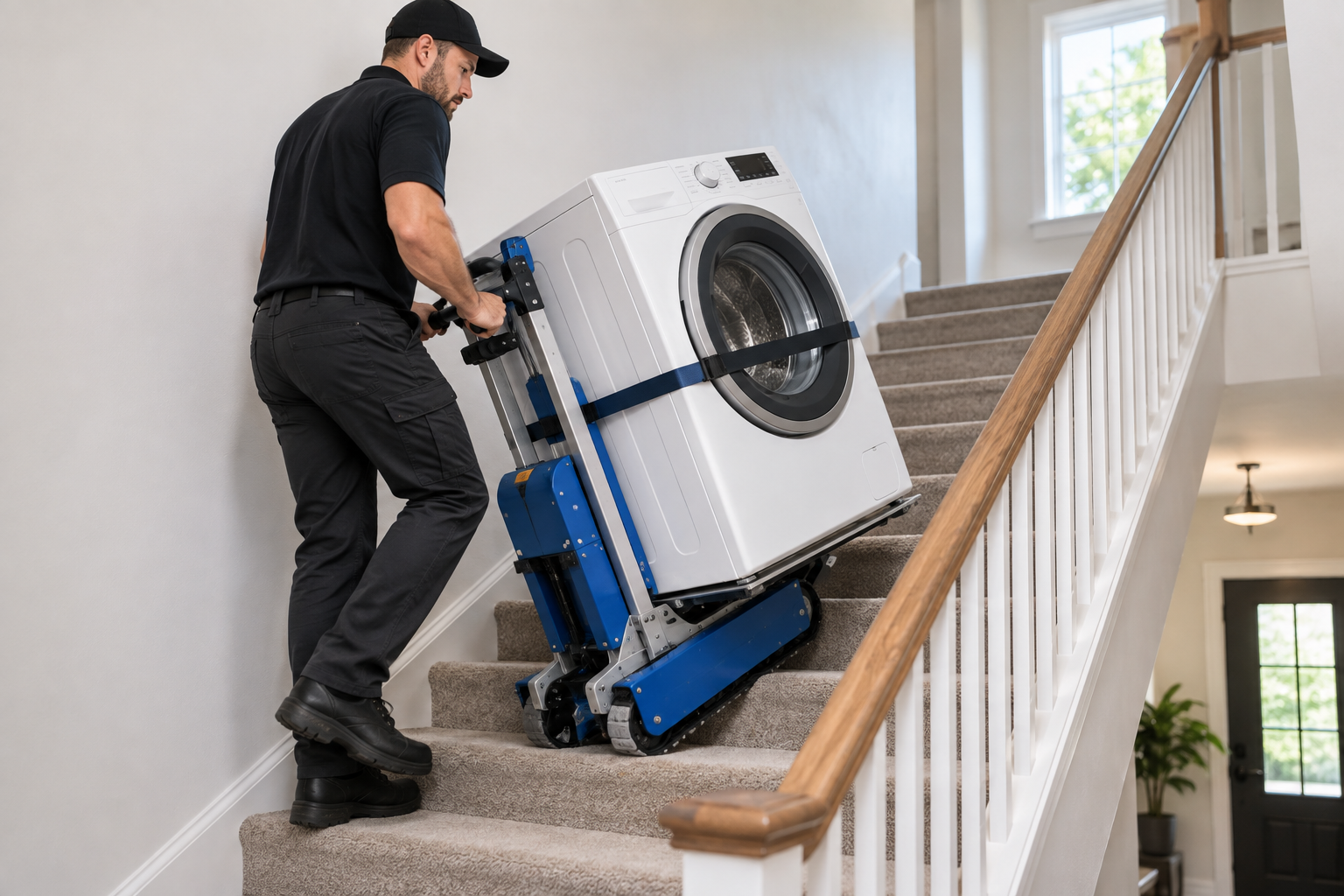
Choosing a powered stair climber for a washing machine requires more than checking the washer against a headline load rating. The actual moving weight, appliance preparation, load stability, operator arrangement, stair geometry and landing clearance all need to fit within verified limits at the same time.
For the broader category, start with our powered stair climber for appliances guide. If you are moving a tall refrigeration load instead, see the refrigerator stair-climber guide.
Start with the washing machine’s actual moving weight
Use the manufacturer’s documentation or model information to establish the washer’s stated weight. Then consider whether the actual load being moved differs because of removable accessories, hoses, packaging or residual water.
Do not assume that a washer which falls below a machine’s advertised capacity is automatically suitable for stairs. The rated load is only the first ceiling; the applicable stair-climbing limit still has to support the real move.
Prepare the washer before evaluating the move
Follow the washing-machine manufacturer’s moving instructions before loading the appliance onto any stair-climbing machine. That can include draining the appliance, managing hoses and power leads, and using transport restraints where the manufacturer requires them.
The stair climber does not replace the washer manufacturer’s transport requirements. An appliance that has not been prepared correctly should not be treated as ready simply because a powered carrier is available.
Rated capacity and stair capacity are different checks
A powered stair climber may have a headline rated capacity that is higher than the permitted load in a particular stair or operator configuration. The relevant number is the verified limit for the conditions that match the planned move.
Our evidence model therefore treats rated capacity as a hard ceiling and then looks for contextual stair-limit evidence. Where the required evidence is missing, the result is insufficient evidence rather than an assumed recommendation.
Check load stability and restraint
Washing machines are dense appliances and need to sit securely against the carrier while the load is restrained according to the stair-climber manufacturer’s instructions. Weight alone does not establish that the appliance can be positioned, supported and restrained correctly.
Check the carrier geometry, support surface or toe plate, permitted securing method and the washer’s position before treating a load match as usable.
Measure the staircase and the complete route
Measure the usable stair width, rise, tread and any other stair limits specified by the equipment manufacturer. Then check the route beyond the individual steps: landings, turns, doorways, approach space and the area needed to load or unload the machine.
A washer may fit within a stair climber’s load limit yet still fail the route because the combined appliance and machine cannot turn or reposition safely at a landing.
Match the operator arrangement to the evidence
If the equipment manufacturer provides different limits for one-person and two-person stair operation, use the limit that matches the planned operator arrangement. Do not use a two-person stair limit as evidence for a one-person move.
The number of operators is therefore part of the load decision, not an afterthought once the machine has been chosen.
Use the selector as a fail-closed evidence gate
The powered stair climber selector only returns a model when the stored evidence supports the relevant load and stair context. It does not turn missing evidence into a recommendation.
You can also review how we evaluate stair climbers to see why rated capacity, contextual stair limits and evidence quality are kept separate.
Washing-machine stair-climber checklist
- Identify the exact washer model and stated weight.
- Account for anything that changes the actual moving load.
- Prepare the appliance according to its manufacturer’s moving instructions.
- Check the stair climber’s rated load as an initial ceiling only.
- Verify the applicable stair-climbing limit for the real stair context.
- Confirm the required operator arrangement.
- Check that the washer can be supported and restrained correctly.
- Measure stair width, rise, tread and other applicable stair limits.
- Measure landing, turning, doorway and approach clearances.
- Confirm the complete route before committing to the move.
The key decision
The best powered stair climber for a washing machine is not automatically the model with the largest advertised capacity. The useful match is the machine for which the washer, operator arrangement and staircase all fit within verified limits together.
Start with the selector, then confirm the remaining preparation and operating requirements against the current instructions for both the washing machine and the stair climber.