
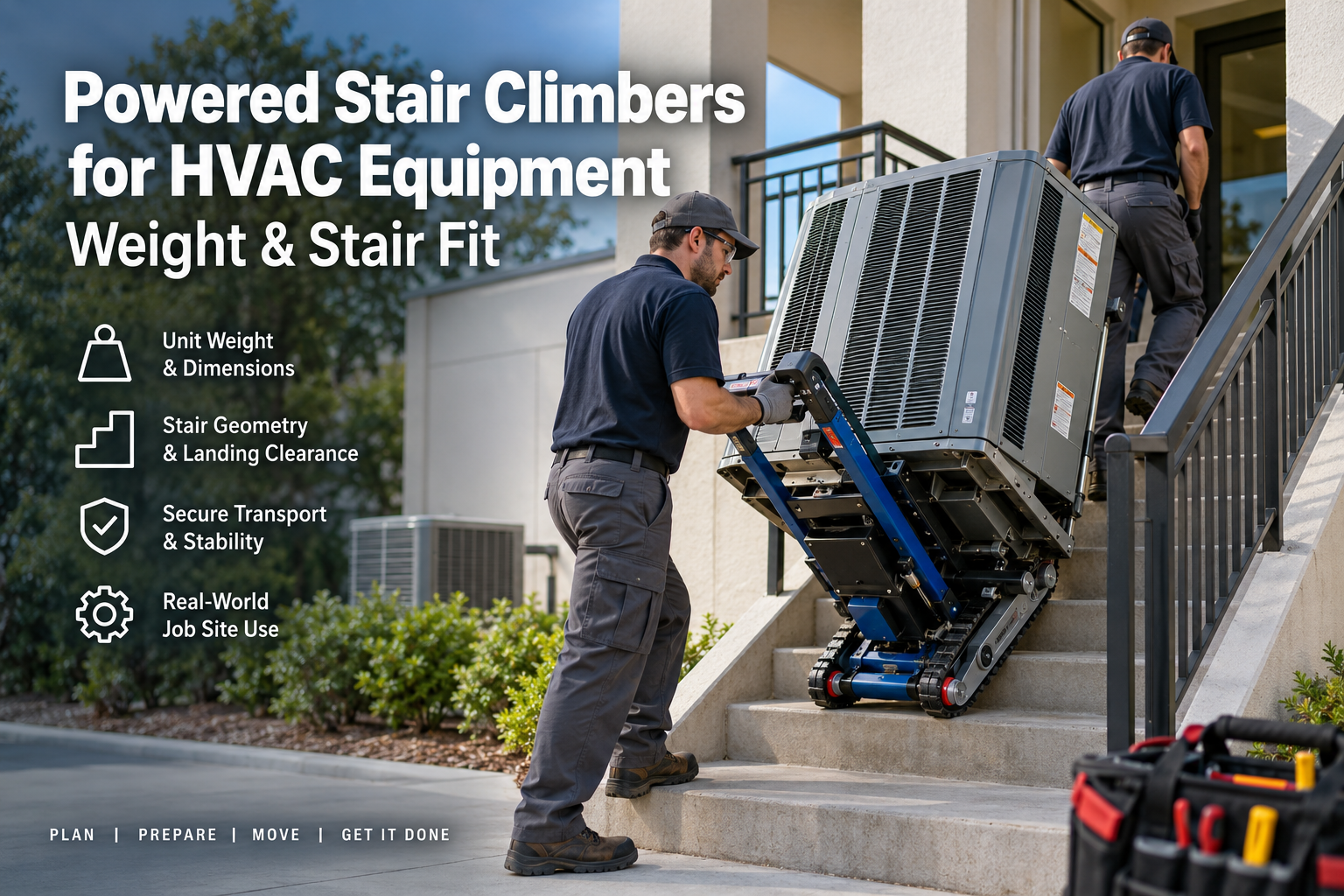
Moving HVAC equipment on stairs is a different problem from simply matching the unit’s stated weight to a machine’s headline capacity. Furnaces, air-handling equipment, condensers and other mechanical units can be tall, deep, fragile or awkwardly balanced, so the complete load profile and staircase have to be considered together.
Why HVAC loads need more than a capacity check
A powered stair climber’s rated capacity is a hard ceiling, but it does not prove that a particular HVAC unit is suitable for stair movement. The actual decision also depends on the machine’s verified stair-load limits, the unit’s dimensions and orientation, how the load is secured, and the available clearance on the route.
Start with the HVAC unit itself
Record the actual loaded weight before choosing equipment. Then check the unit’s height, width, depth and any projections that may affect balance, operator position or stair clearance. A compact heavy unit and a tall mechanical unit can create very different handling problems even when their weights are similar.
Check orientation, stability and securement
HVAC equipment can contain components that make orientation important. Consider which side must face the machine, how the load will be restrained, whether the center of gravity shifts when tilted, and whether doors, panels, coils or other projections could interfere with movement. Do not assume that a unit can be rotated or tilted simply because its total weight is within a machine’s headline rating.
Measure the staircase and landings
Before narrowing the equipment choice, check stair width, tread and riser geometry, turning points, landing depth and any overhead or side clearance that matters during the move. A load that fits on the toe plate may still be unsuitable for a staircase because the complete machine-and-load assembly cannot clear a landing or turn safely.
Use verified stair-limit evidence
The safest comparison is between the actual HVAC load and verified manufacturer or manual evidence for the exact stair-climber model and handling context. Where contextual stair-limit evidence is missing, the site does not treat a rated-capacity match as proof of eligibility.
For the broader framework, see our powered stair climbers for appliances guide, which explains how to compare load type and stair conditions without relying on headline capacity alone.
You can also review powered stair climber capacity and stair limits, use the Stair-Fit Checker to precheck verified route and load-width constraints, continue with the stair climber selector, and read our evaluation methodology.