
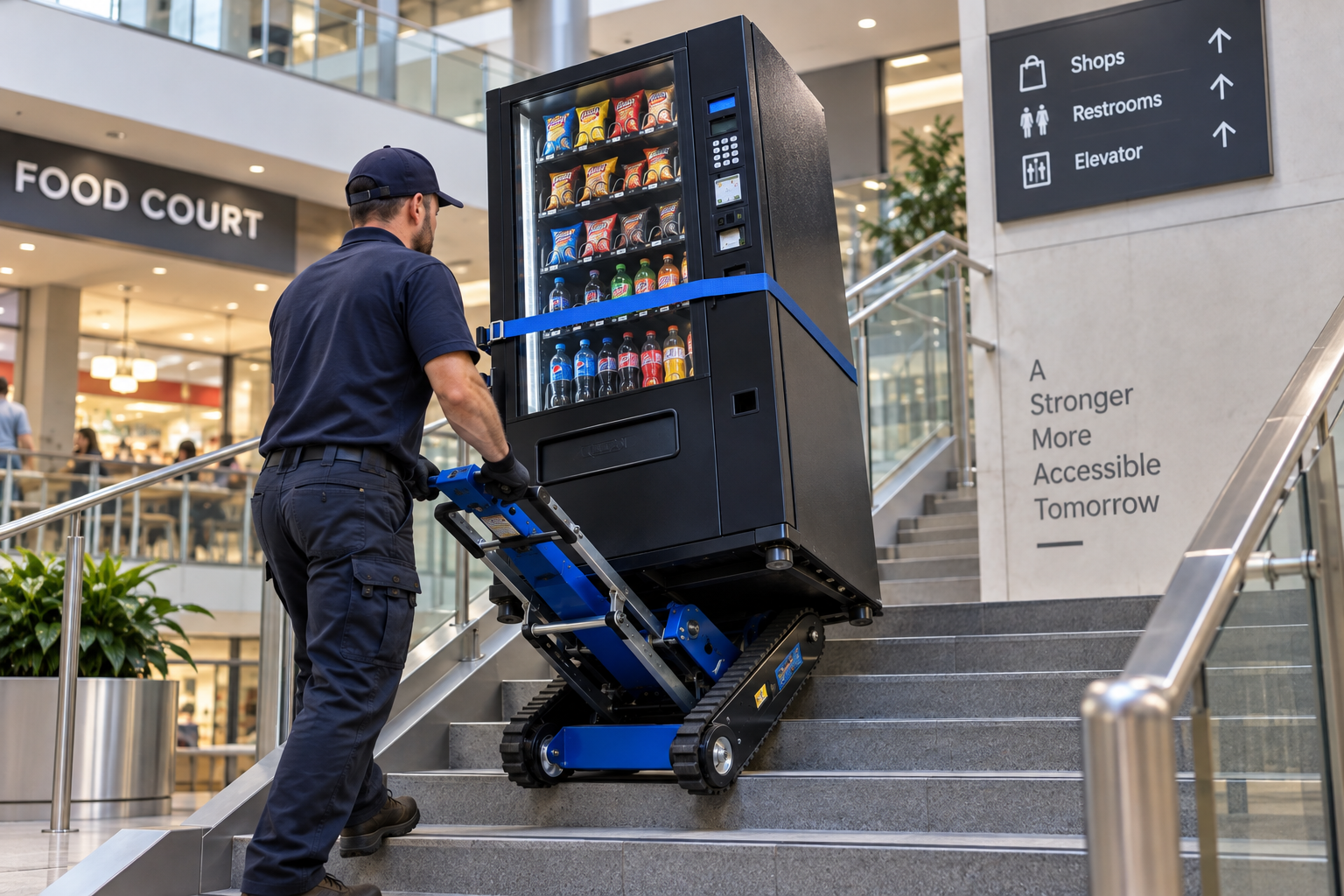
Moving a vending machine on stairs is not simply a question of whether a powered stair climber has a high enough rated capacity. Vending machines combine substantial weight with a tall, bulky shape, so the machine, stairway and handling setup need to be evaluated together before a move.
Start with the actual vending-machine weight
Use the actual weight of the machine being moved rather than estimating from its appearance or category. Machine size, configuration and contents can change the load significantly. If the stated weight is uncertain, confirm it from reliable documentation before selecting handling equipment.
A stair climber’s rated load should be treated as a ceiling, not proof that every load below that number is suitable. Our powered stair climber capacity guide explains why stair-specific limits and operating conditions also matter.
Measure the machine, not just the load
Record the vending machine’s height, width and depth before planning the route. A tall machine can become difficult to control or position even when its weight is within a stair climber’s nominal capacity.
- Confirm that the machine can be supported and secured on the equipment.
- Check that its width can pass through the stairway and any doors on the route.
- Allow for the machine’s depth and tilted transport position.
- Consider where the center of gravity will sit when the machine is secured.
Check the complete stair route
Measure the usable stair width, tread depth and riser height, and check any stated stair-angle restrictions for the stair climber being considered. The route should be assessed as a whole rather than checking only a representative step.
Landings are especially important with a tall rectangular load. Measure the available landing depth and turning space at direction changes. A machine may fit the individual steps but still be unable to rotate or reposition safely at a landing.
Securement and support matter
The vending machine needs a stable interface with the stair climber and a securement arrangement appropriate to the equipment and load. Do not assume that a strap alone resolves a poor fit between the machine and the load platform.
Follow the stair-climber manufacturer’s instructions for load placement, securement, operator requirements and training. If a relevant stair or load condition is not documented, treat it as missing evidence rather than assuming compatibility.
A practical vending-machine fit sequence
- Confirm the machine’s actual weight.
- Measure its height, width and depth.
- Confirm that the load can be properly supported and secured.
- Measure stair width, tread depth, riser height and relevant stair angle.
- Measure landing and turning clearance along the entire route.
- Compare those requirements with verified manufacturer limits for the stair climber.
- Follow the manufacturer’s operator and training requirements.
If you are comparing equipment specifications, use the Stair-Fit Checker to precheck verified load and width constraints against the route, then use the powered stair climber selector to narrow verified configurations and confirm important limits against the underlying evidence. Our methodology explains how PCSC handles specifications and missing evidence.
What this guide does not assume
PCSC does not assume that a model is suitable for vending machines simply because its rated capacity exceeds the machine’s weight. Model-level suitability requires evidence for the relevant load and stair conditions. Where that evidence is unavailable, the correct result is insufficient evidence rather than an unsupported recommendation.