
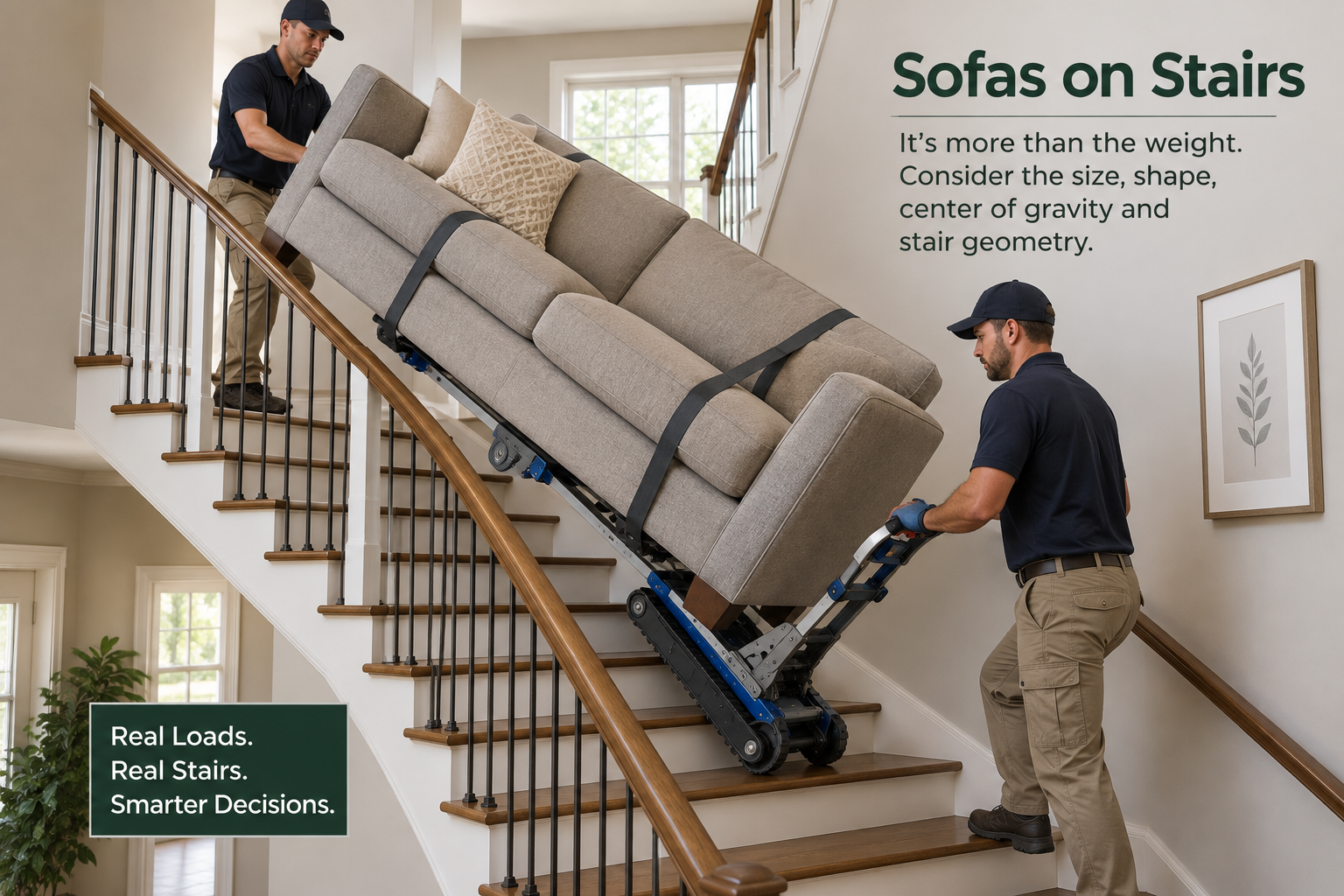
Moving a sofa on stairs is not simply a question of whether the powered stair climber has enough rated capacity. Sofas are long, bulky loads whose shape, overhang and center of gravity can change how the load behaves on the staircase and whether it can clear landings, turns, doors and railings.
Start with the sofa’s actual moving weight
Use the weight of the sofa in the condition in which it will actually be moved. Removable cushions, feet, sleeper mechanisms and detachable sections can materially change the load. Rated capacity should be treated as a hard ceiling, not as proof that a particular sofa-and-stair combination is suitable. Our powered stair climber capacity guide explains why stair-specific limits and load conditions matter alongside the headline rating.
Length and overhang matter
A sofa can be relatively light while still being difficult to move because much of its length extends beyond the stair climber’s support area. Long overhang can affect balance, operator clearance and the space required at the top and bottom of the staircase.
Measure the sofa’s overall length, depth and height rather than relying only on the manufacturer’s nominal size. If legs, arms or other projections cannot be removed, include them in the moving envelope.
Check the center of gravity and load orientation
The sofa needs a stable orientation on the machine. A load that is secure on level ground may behave differently as the stair climber changes angle on the staircase. The important question is not merely whether the sofa can be strapped to the machine, but whether its weight can remain controlled in the intended orientation throughout the route.
Sleeper sofas and reclining sofas deserve particular care because internal mechanisms can shift a large share of the weight toward one section of the load.
Measure the staircase, not just the sofa
Record stair width, tread depth, rise and any relevant stair-angle or step-limit information required by the equipment manufacturer. Then check the entire route for handrails, walls, door frames and other obstructions.
A machine that can climb the individual steps can still be unsuitable if the combined machine-and-sofa envelope cannot enter, exit or turn safely.
Landing and turning clearance can be the limiting factor
Long furniture often exposes a problem that compact appliances do not: the landing may be large enough for the stair climber but too small for the stair climber and sofa together.
Measure intermediate landings, ninety-degree and switchback turns, the top landing and the approach to the staircase. Consider the space needed for the load itself as well as the operators controlling it.
Plan the complete route before choosing equipment
Check the route from the sofa’s starting position to its final destination. Doorways, hallways, elevators, exterior steps and tight transitions can determine whether the move is practical even when the main staircase appears suitable.
For the broader furniture-selection framework, including shape, center of gravity and route planning across different furniture types, see our powered stair climbers for furniture guide.
Do not assume a one-operator move
Operator requirements depend on the equipment, the load and the staircase. A sofa’s size can require additional control even when its weight is well below the machine’s maximum rating. Follow the manufacturer’s operating instructions and any load- or stair-specific operator requirements.
Use verified stair limits
PCSC separates general rated capacity from contextual stair-limit evidence. When the required stair or load condition is not supported by verified evidence, we treat that as insufficient evidence rather than assuming suitability.
You can use the PCSC stair climber selector to compare only the verified conditions currently represented in our structured data. For how we grade manufacturer specifications and other evidence, see how we evaluate stair climbers.
Sofa stair-climber checklist
- Confirm the sofa’s actual moving weight.
- Measure overall length, depth and height.
- Identify removable and non-removable projections.
- Consider where the sofa’s center of gravity is likely to sit.
- Choose a stable load orientation before the move.
- Measure stair width, rise and tread depth.
- Check landing and turning clearance for the combined load.
- Inspect doorways, rails, walls and the complete travel route.
- Verify applicable stair limits and operator requirements.
- Do not infer suitability where manufacturer evidence is missing.