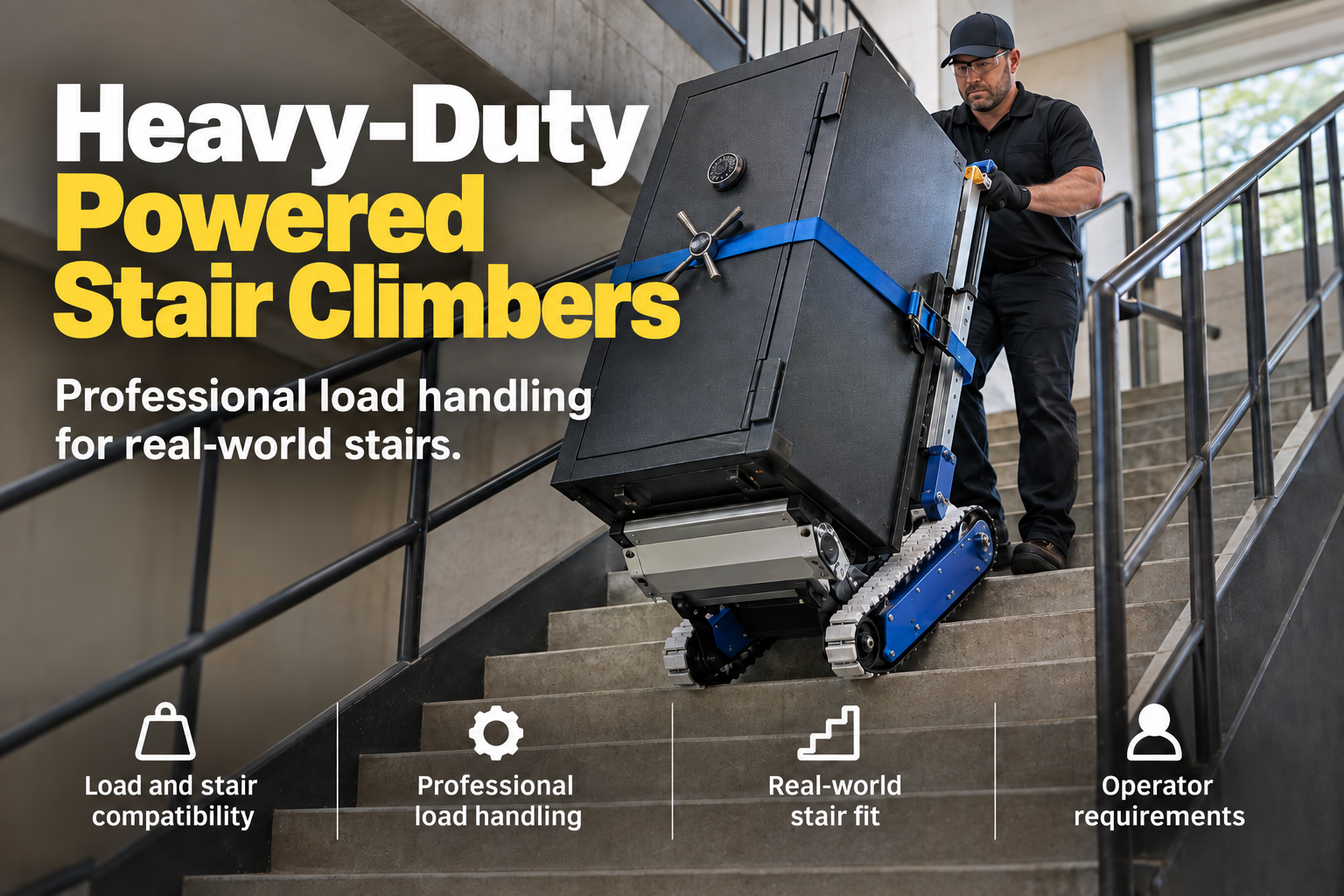
Heavy-duty powered stair climbers are intended for demanding load-moving work, but “heavy duty” is not a single capacity threshold. A professional buyer needs to consider the load, workload, machine architecture, operator requirements and staircase together rather than choosing equipment from the headline pound rating alone.
What makes a stair climber heavy duty?
For PCSC, heavy duty describes a machine class and operating requirement rather than an arbitrary number printed on a specification sheet. Relevant factors include the type and frequency of work, the weight and geometry of the loads, the machine’s own size and weight, how the load is supported and secured, operator requirements, and the stair conditions under which the manufacturer has actually documented performance.
If your main question is what a capacity figure means, use our powered stair climber capacity guide. That page owns rated-capacity and contextual stair-limit interpretation. This guide focuses instead on choosing a heavy-duty machine class for professional work.
Start with the job, not the maximum rating
A machine used occasionally for one known load presents a different selection problem from equipment expected to move varied heavy loads throughout a working week. Before comparing machines, define the actual operating pattern.
- What are the heaviest real loads you expect to move?
- Are the loads compact and dense, tall, bulky or difficult to balance?
- Will the machine be used occasionally or repeatedly during professional work?
- Does it need to be transported frequently between sites?
- What support and securement arrangement does the load require?
- How many operators are required under the relevant manufacturer guidance?
- What staircase and landing constraints apply on the actual route?
Machine weight and portability still matter
A higher-capacity machine can itself be substantially heavier. That can affect vehicle loading, repositioning away from the stairs and day-to-day handling between jobs. Professional selection therefore involves a trade-off between load capability and the practical burden of moving the stair climber itself.
Support and securement are part of heavy-load fit
A heavy load needs an appropriate interface with the stair climber. Toe-plate width, load position and the manufacturer’s securement system can all affect whether a particular load can be carried as intended. A high rated capacity does not compensate for inadequate support or an unsuitable load position.
Verified PowerMate examples show why ratings need context
PCSC currently has verified structured records for the PowerMate L-1, M-1 and M-2B. Their stored headline capacities span 650 lb to 1,500 lb, but our verified contextual load-limit records also show why the headline figure cannot be treated as blanket stair approval.
For example, PCSC’s current verified records contain 14 contextual load-limit entries for each of those three PowerMate models. The maximum contextual values in those records are 650 lb for the L-1 and 1,000 lb for both the M-1 and M-2B. Those values are evidence examples, not universal limits for every staircase, load position or operating configuration.
The M-1 and M-2B records also illustrate another professional-use trade-off: both carry a 1,500 lb headline rating in our verified data, while their recorded machine weights are 165 lb and 185 lb respectively. The M-2B has a recorded 27-inch toe-plate width versus 24 inches for the M-1. These differences can matter to load support and transport even when two machines share the same headline rating.
Operator requirements must be verified, not assumed
Do not infer that a machine is a one-person or two-person solution from its capacity label. Operator requirements can depend on the model, load, movement type and manufacturer instructions. Where PCSC does not have verified evidence for a required operating condition, we treat that condition as unknown rather than filling the gap with an assumption.
Heavy duty does not remove the stair-fit problem
Even a machine with adequate verified load capability can fail the job if the route does not fit. Stair width, rise, tread, slope, landing depth, turns and the dimensions of the secured load still matter. A professional selection process must evaluate the full route rather than treating capacity as permission to proceed.
A practical heavy-duty selection sequence
- Define the actual loads and professional workload.
- Record load weight, dimensions and relevant balance or support requirements.
- Identify the machine architecture suitable for the work.
- Check machine weight and portability between jobs.
- Verify load support and securement requirements.
- Confirm any operator requirements from authoritative evidence.
- Compare headline capacity with verified contextual load limits.
- Measure the stairs, landings and turns on the intended route.
- Reject any model where a required condition cannot be verified.
Use PCSC’s evidence before narrowing the model list
Before narrowing the model list, use the Stair-Fit Checker to precheck verified load and width constraints against the intended route.
The Powered Stair Climber Selector is designed to narrow equipment using verified load and stair evidence rather than merchant availability or headline capacity alone. You can also review the current powered stair climber model database and our evaluation methodology to see how specifications, conflicts and missing evidence are handled.
PCSC does not define “heavy duty” by a single pound threshold and does not recommend a model merely because it has the highest headline capacity. The correct result can be conditional or insufficient evidence when the load, operator or stair conditions cannot be verified.